
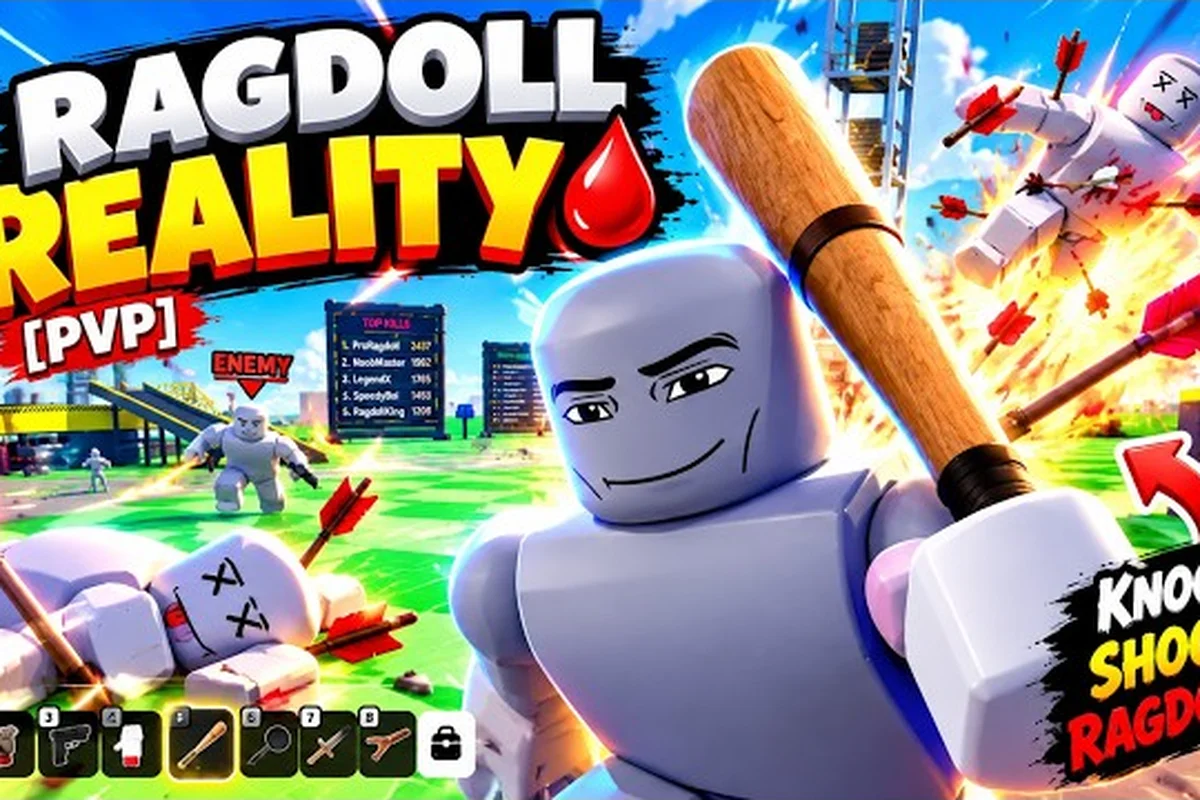
A useful ragdoll reality tier list depends on the job: precision beats raw force in a duel, while explosives dominate crowds. This 2026 ranking compares more than 20 weapons by practical sandbox performance.
How This Tier List Was Judged
This ragdoll reality tier list is an editorial comparison rather than an official damage chart. The official Ragdoll Reality game page names Fists, Bat and Machete for close impact; Push and Grab as movement tools; Pistol, Shotgun, Sniper and Minigun for range; Rocket Launcher, Flamethrower and C4 for heavy effects, while also indicating that more weapons exist. It does not publish damage, ammunition, cooldown, or fire-rate figures, so there is no verified statistical basis for claiming one weapon is universally stronger.
The rankings instead reflect the role each tool performs inside the physics sandbox. Precision, reach, crowd pressure, explosive force, control, and ease of use receive different weight depending on the encounter. That makes the ragdoll reality best weapons tier list more useful than a simple ladder: S-tier weapons are exceptional specialists rather than universal replacements for every tool.
| Judging factor | What it measures | Why it matters in Ragdoll Reality |
|---|---|---|
| Precision | Ability to hit a specific target | Rewards controlled duels and long-range positioning |
| Range | Useful distance from the target | Creates time to aim, reposition, or retreat |
| Crowd pressure | Capacity to affect multiple dummies | Supports horde and wave scenarios |
| Physics force | Visible impact and displacement | Improves knockback, launches, and chaotic combos |
| Versatility | Number of situations where the tool remains useful | Keeps a dependable option available across modes |
| Reliability | Consistency without excessive setup | Helps during fast, unpredictable encounters |
These factors produce a practical ragdoll reality weapon tier list. A weapon can excel in one column but fall because its weaknesses become costly elsewhere. The most balanced choices tend to survive repeated use, while a specialist becomes dominant only when the player creates the right conditions.
Tiers and ranking rules
Each tier contains editorial placements, not locked game statistics. S-tier represents excellent peak performance, A-tier indicates a strong all-around tool, B-tier covers dependable or situational choices, and C-tier emphasizes specialized value that can still shine in the right hands. This structure keeps the ragdoll reality tier list 2026 readable without pretending that hidden data has been verified.
The official page also indicates that weapon unlocks are tied to kills, although it gives no thresholds. Consequently, access can influence real-world usefulness. A newly available weapon may rank well while remaining unavailable during a player’s first few sessions, and the Ragdoll Reality Roblox guide provides a useful starting point for learning the core sandbox loop.
S-Tier Weapons in the Tier List
The ragdoll reality s tier weapons lead the ranking because they create major advantages when their preferred targets are present. They are not equally strong in every situation: the Sniper rewards careful positioning, the Minigun blankets a group, and the Rocket Launcher turns spacing into explosive damage.
| Rank | Weapon | Main strength | Best use | Main limitation |
|---|---|---|---|---|
| 1 | Sniper | Long-range precision | Distant targets and protected positioning | Reward depends on an accurate shot |
| 2 | Minigun | Sustained crowd pressure | Dense groups and moving targets | Can feel excessive against isolated targets |
| 3 | Rocket Launcher | Explosive area force | Clusters, launches, and staged scenarios | Splash value is less useful against one small target |
| 4 | Machete | Fast close-range impact | Immediate melee finishes and crowd cuts | Leaves little room for ranged safety |
| 5 | Flamethrower | Persistent area denial | Tight groups and controlled zones | Narrow coverage and close exposure |
Precision and explosive specialists
Sniper earns its place through target prioritization. The official game page includes the Sniper among the named weapons but supplies no numerical stats, so the ranking is based on the function normally associated with a precision firearm: selecting a distant target while avoiding close engagement. For a deeper comparison, the Sniper weapon review compares it with several practical rivals.
Rocket Launcher provides the opposite advantage. Its value comes from group disruption, since an explosive impact can affect a cluster and produce dramatic displacement. Because the page does not state splash radius or exact damage, players should treat explosive outcomes as observable rather than mathematically guaranteed. The strongest use is often to soften a group before switching to a more precise weapon.
Melee and area-control leaders
Machete combines close reach with rapid impact, making it one of the clearest ragdoll reality s tier weapons. Bat still delivers satisfying physical knockback, but the Machete’s direct cutting theme suggests stronger immediate pressure when a target is already within reach. Fists remain valuable for testing movement and practicing the controls, although they occupy a very different role from the top finishers.
Flamethrower is the most control-oriented S-tier option. Its practical strength comes from shaping a dangerous space around a group rather than landing one exceptionally precise hit. Because the official source does not publish flame duration or range, the rating reflects role and expected sandbox behavior, not confirmed performance numbers. Anyone focused on large waves can also consult the best weapon for hordes.
A-Tier Weapons That Anchor the Weapon Tier List
The ragdoll reality a tier weapons provide strong performance without demanding the same precision or positioning as S-tier picks. They can handle ordinary encounters, contribute meaningfully to groups, or offer a more specialized effect that becomes excellent under the right conditions.
| Rank | Weapon | Primary advantage | Ideal scenario | Tier reason |
|---|---|---|---|---|
| 6 | Shotgun | Flexible close-range output | Medium range and scattered targets | Excellent when several enemies threaten the player |
| 7 | Bat | Strong physical knockback | Open areas and solo targets | Reliable impact without a ranged wind-up |
| 8 | Pistol | Accurate general-purpose fire | Mid-range duels and controlled fights | Useful across many situations, but less explosive |
| 9 | C4 | Deliberate environmental demolition | Prepared traps and clustered targets | High force when placement is handled carefully |
| 10 | Push | Non-damaging displacement | Repositioning and crowd control | Valuable utility rather than conventional damage |
| 11 | Grab | Direct ragdoll manipulation | Moving, stacking, or exposing targets | Excellent control when precise placement matters |
| 12 | Machete Alternate | Fast melee pressure | Close encounters | Strong impact, with overlap against the primary Machete |
Balanced combat choices
Shotgun is the most flexible member of this group. It can punish an approaching target without demanding sniper-level aim, yet it lacks the same raw area potential as a rocket. Pistol is less spectacular, but that is part of its value: it serves as a dependable option when the scene changes quickly or ammunition conservation matters, even though the official page does not publish ammunition counts.
Bat and the Machete occupy related but distinct positions. The Bat emphasizes displacement and physical comedy; the Machete feels more direct in a close confrontation. A closer look at underrated C-tier utility picks explains why lower-ranked tools can still outperform an exciting option in a narrow test.
Utility over raw elimination
Push and Grab may not fit a conventional damage ranking, but they create opportunities in a physics sandbox. Push can separate a target from a hazard or cluster without necessarily removing it, while Grab offers deliberate control over a ragdoll’s position. Their limitations are equally clear: neither creates the immediate elimination pressure of a firearm or explosive.
C4 sits between those tools and conventional explosives. It rewards preparation, allowing players to use the environment rather than relying only on aim. However, its effectiveness depends on placement and timing, so a high explosive ceiling does not guarantee that it is the most convenient weapon. This makes it an A-tier specialist rather than an S-tier default.
B-Tier Weapons with Reliable Sandbox Value
The ragdoll reality b tier weapons remain useful because they cover practical needs, provide contrasting approaches, or support specific situations. They are not necessarily disappointing; they are simply less dominant when measured across precision, range, crowd control, and force at the same time.
| Rank | Weapon | Main contribution | Useful situation | Why it stays in B tier |
|---|---|---|---|---|
| 13 | Fists | Basic physical attacks | Practice and close-range play | Low complexity but limited range and pressure |
| 14 | Minigun Alternate | High-volume fire | Moving crowds | Excellent burst value, less efficient for single targets |
| 15 | C4 Alternate | Area trap potential | Ambushes and stacked targets | Strong when prepared, weaker during spontaneous fights |
| 16 | Bat Alternate | Heavy knockback | Open-space targets | Relies more heavily on physical positioning |
| 17 | Pistol Alternate | General ranged option | Standard engagements | Useful but less distinctive than the primary pistol |
| 18 | Flamethrower Alternate | Sustained crowd denial | Tight spaces | Exposes the player and needs suitable positioning |
| 19 | Shotgun Alternate | Close-range burst damage | Immediate threats | Great in a short window, limited by target spacing |
| 20 | Sniper Alternate | Long-range accuracy | Distant isolated targets | Narrower use when the arena becomes crowded |
Situational strength and consistency
A B-tier weapon is worth keeping in mind when its exact function matches the encounter. Fists may seem weak beside a sniper or rocket, yet they require the least setup and make the physical interaction easy to understand. A player learning movement can use them while becoming comfortable with ragdoll momentum and targeting.
The alternate placements in this table represent broader weapon families and available implementations rather than separate official damage classes. The official page names 12 weapons and adds “and more,” but it does not publish a complete unlock order or numerical roster breakdown. This is why the 2026 ragdoll reality tier list treats each named weapon as a functional role and uses additional slots to reflect the broader sandbox experience without inventing statistics.
B-tier tools in longer matches
Longer sessions create a different evaluation. A spectacular weapon with a short ideal window can become less valuable if the player repeatedly changes targets, while a reliable option can support experimentation. The official game page mentions a Horde mode, and its graveyard system turns thrown dummies into zombies with slow, normal, and fast speed classes. Since zombie health, bite damage, and wave population are not published, B-tier rankings in those modes depend on observed utility rather than confirmed survival mathematics.
Choosing the Right Weapon by Combat Scenario
A strong ragdoll reality best weapons tier list is not simply a declaration of the best gun. It should help you select the right tool for distance, target count, available space, and the result you want from a physics interaction.
| Combat need | Recommended choice | Secondary choice | Reasoning |
|---|---|---|---|
| One distant target | Sniper | Pistol | Prioritize accuracy and reaction time |
| Several nearby targets | Shotgun | Machete | Reward immediate area pressure |
| Dense moving crowd | Minigun | Flamethrower | Maintain continuous crowd control |
| Cluster in the open | Rocket Launcher | C4 | Convert grouping into explosive force |
| One target in an open area | Bat | Fists | Emphasize knockback and physical impact |
| Reposition a target | Push | Grab | Prioritize manipulation over damage |
| Stacked or trapped targets | C4 | Rocket Launcher | Use placement to multiply impact |
Distance and target density
Target density changes the meaning of a weapon. Against one distant dummy, the Sniper has a clear advantage because range and precision matter more than area coverage. Against a tight mass of targets, the Minigun or Flamethrower becomes more practical because each shot or burst can pressure several bodies at once. Players comparing that weapon in more detail can use the Minigun crowd-control analysis.
A practical test is to ask what happens after the first successful hit. If the target falls instantly, raw area may be unnecessary. If it survives and keeps moving, sustained fire becomes more valuable. This simple reasoning produces a more reliable loadout than memorizing a static ranking, especially because the official page does not disclose health thresholds or ammunition quantities.
Space, positioning, and desired effect
The desired visual effect also affects weapon choice. Rocket Launcher produces the largest displacement, Bat emphasizes momentum, and Push creates room without requiring a kill. If the goal is experimentation, Grab may be more valuable than a weapon that removes the target immediately. If the goal is an elimination challenge, precision firearms and explosive tools become much stronger choices.
Beginners should combine one dependable ranged option with one close-range tool. A Pistol paired with Bat or Machete covers two distinct threat distances without making every encounter dependent on one special condition. More experienced players can then test specialist tools such as Sniper, Rocket Launcher, or C4 once they understand how enemies, props, and ragdoll collisions affect a fight.
C-Tier Picks and the Limits of a Weapon Ranking
C-tier weapons occupy the lower part of this ragdoll reality tier list because their strongest features are easier to replace under ordinary conditions. That does not make them useless. It means the current ranking cannot identify one universal choice among the broader set of available tools, especially where the official information does not separate every implementation clearly.
| Category | Lower-ranked option | Best use | Upgrade condition |
|---|---|---|---|
| Basic impact | Fists | Learning close-range physics | Better only when accessibility outweighs power |
| Secondary explosive | C4 Alternate | Careful staged traps | Better after the player masters placement |
| Secondary ranged | Pistol Alternate | Standard mid-range pressure | Better if it handles recoil or control differently |
| Secondary melee | Bat Alternate | Open-space knockback | Better if it creates a distinct physics effect |
| Secondary heavy fire | Minigun Alternate | Large target clusters | Better with a practical ammunition advantage |
Why lower tiers remain worth using
The game’s physical interactions can make situational value harder to measure than ordinary damage. A tool that appears weak during a direct duel may be excellent for throwing a target into the graveyard, where the official page says it can become a zombie. That conversion mechanic adds a different objective: controlling where a body lands may matter more than eliminating it immediately.
C4 and alternate explosive tools can also turn an environmental feature into an advantage. The problem is reliability. A specialist requires the player to create a cluster, choose a position, and trigger the effect at the right moment. During a fast wave, those steps may cost more than they save. That is why a lower placement does not mean a weapon lacks potential; it means the potential demands more setup.
Accuracy limits and update sensitivity
This ranking should be read as an editorial snapshot, not a permanent verdict. Weekly updates can introduce weapons that are not yet documented, and balance adjustments may alter how an existing tool feels. The official page’s update schedule and unlock language also suggest an active catalog, so the ragdoll reality tier list 2026 should be revisited when new equipment appears.
The best way to update your own judgment is to record three things after testing: whether the weapon hit reliably, whether it changed target positions, and whether it contributed to the objective. Those observations are more defensible than an unsupported damage percentage and remain useful even when the tier placement changes.
Practical Loadouts for Different Play Styles
Rather than equipping only the highest-ranked item, build a loadout around the problem you expect to face. A three-slot plan is enough for most early testing, and each slot should cover a different distance or type of response.
| Play style | Slot 1 | Slot 2 | Slot 3 |
|---|---|---|---|
| Precision | Sniper | Pistol | Push |
| Crowd pressure | Minigun | Shotgun | Rocket Launcher |
| Melee physics | Machete | Bat | Grab |
| Explosive specialist | Rocket Launcher | C4 | Pistol |
| New-player generalist | Shotgun | Bat | Pistol |
Generalist setup
A generalist setup should place Shotgun in the first slot, Bat in the second, and Pistol in the third. Shotgun handles nearby groups, Bat supplies close-range knockback without requiring ammunition, and Pistol covers medium distance. This combination remains understandable because each tool addresses a different threat level, and the first-hour plan can help organize the early testing process.
Specialist setup
Precision players can use Sniper, Pistol, and Push. The Sniper rewards careful positioning, Pistol covers a missed long-range attempt, and Push creates separation when a target closes the gap. This loadout is less explosive than a rocket-centered build, but it offers more control over how the encounter unfolds.
Players who enjoy staged traps can pair Rocket Launcher, C4, and Grab. Grab positions the target, C4 creates a prepared hazard, and the Rocket Launcher resolves the remaining cluster. The weakness is speed, so this build works best when the player can shape the battlefield before the decisive action.
Frequently Asked Questions
What is the strongest weapon in Ragdoll Reality?
There is no officially published damage chart, so the strongest weapon depends on the task. Sniper leads for precise long-range targets, Minigun for dense crowds, Rocket Launcher for explosive group force, and Machete for fast close-range impact. The best choice changes with target count, distance, and available space.
Is Sniper the best weapon in the game?
Sniper is among the best choices when precision and distance matter most, but it is not the universal winner. It can struggle when targets are numerous, very close, or moving unpredictably. A Pistol or Shotgun becomes more useful in those situations because they offer faster follow-up opportunities and broader coverage.
Which weapon is best for zombie hordes?
Minigun is the strongest crowd-control option because sustained fire can pressure multiple moving targets, while Flamethrower can deny a tight area. Rocket Launcher is better when zombies are grouped. In the official Horde mode, exact health and wave details are unpublished, so weapon efficiency should be judged from observed results.
Are C tier weapons worth using in Ragdoll Reality?
Yes, because tier depends on context rather than a simple damage scale. Fists can help new players learn physical movement, Push and Grab reposition targets, and secondary explosives can win prepared encounters. They rank lower when a stronger option is equally easy to use, but they remain valuable for specific objectives and experiments.
How should I update the Ragdoll Reality tier list?
Compare weapons using precision, range, crowd pressure, physics force, versatility, and reliability. Test the same target arrangement with each tool and record whether it hits, displaces the target, and completes the objective. Recheck the list after updates, especially because the official game page says the catalog includes more weapons than the twelve it names.