
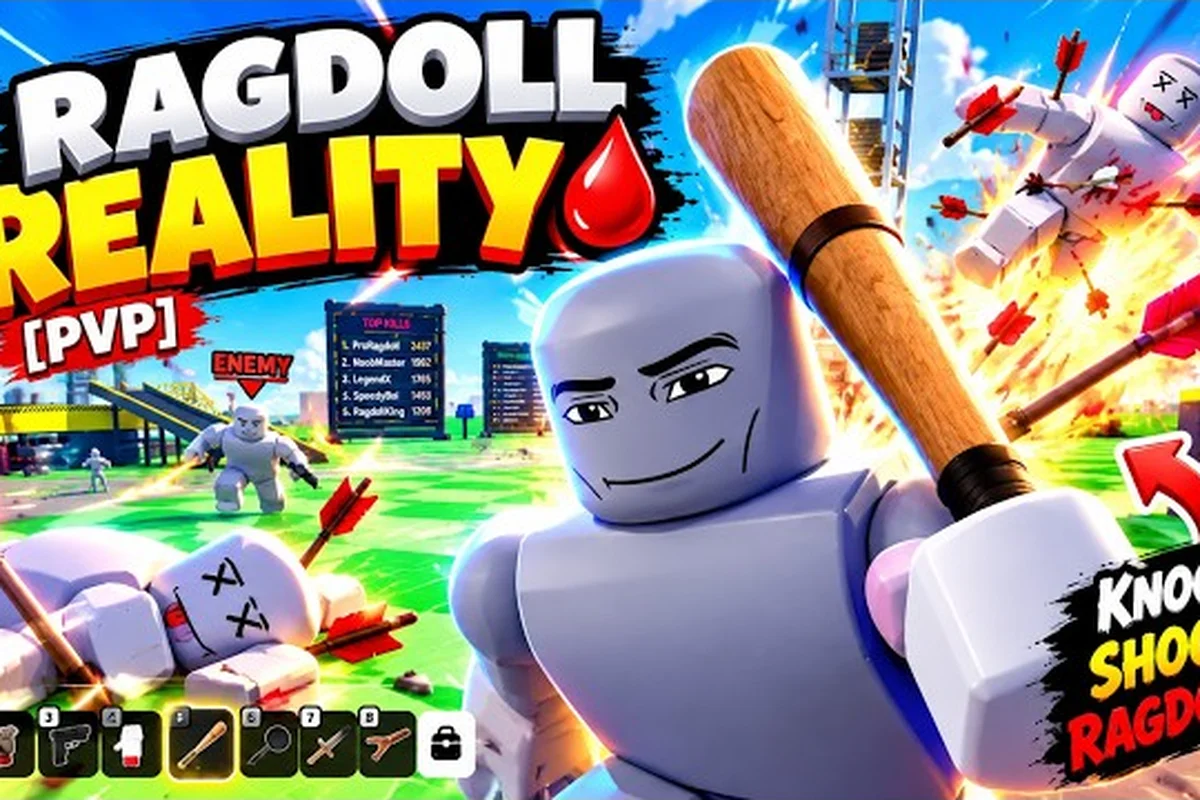
Ragdoll Reality is machete good once you weigh reach, swing feel, and limb precision against the rest of the close-range roster. This role check explains where the machete earns a slot, where the bat answers better, and which encounters reward a different tool.
Machete Verdict and Role Test
Ragdoll Reality is machete good because it combines broad swing reach, fast close-range pressure, and convincing physics impact, but it is not the best answer to every encounter. This 12-weapon role check compares the machete with the bat and six major alternatives, showing when each tool deserves a place in your loadout.
Why the Machete Stands Out in Ragdoll Reality
The machete’s strongest advantage is the space it gives you between your dummy and danger. A long blade can reach across a clustered group, clip an approaching limb, or finish a ragdoll after a blast, while the bat trades some reach for a heavier, more compact swing. That difference changes positioning more than a simple damage number would.
This matters because the game’s damage, ammunition, and cooldown figures are not published on the official Ragdoll Reality page. Any useful weapon ranking must therefore be framed around observable role: reach, control, target selection, and physics feel. The official roster names Fists, Bat and Machete for close impact; Push and Grab as movement tools; Pistol, Shotgun, Sniper and Minigun for range; Rocket Launcher, Flamethrower and C4 for heavy effects, but it does not rank them.
That limitation makes a tier label less absolute. Player experience suggests that a machete can be excellent for precise dismemberment and quick multi-target contact, yet a pistol, sniper, or explosive tool may feel stronger in a different sandbox objective. Treat the verdict below as a practical role-based evaluation, not an official power ranking.
| Question | Machete answer | Why it matters |
|---|---|---|
| Is the machete good? | Yes, especially up close | It combines reach with rapid swinging |
| Is it better than the bat? | Usually for reach and target precision | The bat favors heavy, compact impact |
| Best against zombies? | Strong, but not universal | Swing timing matters when several enemies converge |
| Best sandbox activity? | Limbs, ragdolls, crowded targets | Wide arcs can contact multiple bodies |
| Main weakness? | Narrow defense window | Missed swings leave you exposed |
| Tier judgment | High-tier melee option | Strong utility without published stats |
The short answer
Yes, the machete is good. It is one of the most flexible melee choices because it gives the player a practical balance between swing speed and reach. It also feels more precise than tools whose value comes mainly from explosive area damage. If your goal is controlled ragdoll experimentation, the machete lets you choose individual limbs or bodies without immediately destroying the entire setup.
That does not make it the universal answer. The bat can be more satisfying when a compact, forceful strike is the priority, while a shotgun offers a different way to control a tight group. The strongest Ragdoll Reality weapon meta depends on whether you value precision, crowd pressure, raw force, or long-range control.
Machete Against the Bat and Seven Alternatives
To judge whether the machete deserves a high placement, it needs more than a favorable description. The useful comparison is against weapons that can solve a similar problem: damaging a ragdoll at close range, moving limbs deliberately, or creating enough force to break a controlled setup.
| Weapon | Primary role | Reach or range | Precision | Best use |
|---|---|---|---|---|
| Machete | Sweeping melee cuts | Medium-high | High for limbs | Precise dismemberment |
| Bat | Heavy close-impact swings | Short-medium | High | Strong local knockback |
| Fists | Basic melee | Very short | Moderate | Free-form testing |
| Push | Manipulation | Short | High | Move without necessarily damaging |
| Grab | Manipulation | Short | High | Reposition targets |
| Pistol | General ranged damage | Medium | High | Controlled single shots |
| Shotgun | Burst damage | Medium | Medium | Tight groups |
| Sniper | Long-range precision | Very long | Very high | Isolated targets |
| Minigun | Sustained crowd pressure | Medium-long | Low-medium | Dense formations |
| Rocket Launcher | Area explosion | Long | Low | Large knockback |
| Flamethrower | Sustained area fire | Medium | Low-medium | Groups and lingering damage |
| C4 | Placed explosive | Variable | Medium | Prepared area destruction |
The table separates mechanical role from tier. A weapon can be excellent in a narrow test without being a universal meta pick. Conversely, explosives and ranged weapons may look less precise but give the player more room to experiment because the target does not need to remain within arm’s reach.
Machete versus bat
The answer to whether the machete is good also depends on whether the bat is good. Both are close-range impact tools, but their strengths point in different directions. The machete has the better case for long limbs, narrow gaps, and controlled contact because its extended shape gives the swing a larger effective footprint. The bat is the better candidate for a compact hit when you want a blunt, dramatic impact and are willing to work at closer range.
| Comparison factor | Machete | Bat | Verdict |
|---|---|---|---|
| Swing footprint | Extended blade | Shorter club | Machete |
| Fine limb targeting | Strong | Good | Machete |
| Blunt force feel | Moderate | Strong | Bat |
| Close-quarters crowd contact | Good | Good | Tie |
| Reach over a fallen body | Better | Limited | Machete |
| Overall melee role | Precision cutter | Heavy hitter | Depends on goal |
When evaluating Ragdoll Reality is bat good, its value becomes clearest in controlled one-on-one tests and compact setups. It can be less forgiving when a target is lying down or when multiple bodies are packed close together. The machete gives you a little more room, although neither blade nor bat solves the underlying problem of committing to a bad swing.
Machete versus the other close-range tools
Fists, Push, and Grab are important comparisons because they change the objective. Fists are the baseline melee option. Push and Grab are manipulation tools that can move a body without necessarily dealing conventional damage, so they often matter more in sandbox tests than a direct weapon comparison would suggest. The machete does not replace those functions, but it offers a more aggressive option when the player’s intention is to cut rather than reposition.
This is a key part of the current Ragdoll Reality weapon meta: the strongest tool depends on the experiment. If the goal is to preserve a body for later manipulation, a non-damaging option may be better. If the goal is to remove an arm cleanly, the machete’s shape becomes a major advantage.
Machete versus ranged and explosive tools
Pistol, Shotgun, Sniper, Minigun, Rocket Launcher, Flamethrower, and C4 do not compete with the machete on the same axis. They trade the machete’s close-range precision for range, area pressure, or preparation. A sniper can isolate a distant body; a shotgun can punish a compact group; a rocket can create dramatic displacement; and C4 rewards planned positioning.
| Enemy situation | Better starting choice | Reason |
|---|---|---|
| One nearby dummy | Machete | Immediate, controlled melee |
| Several bodies in a tight cluster | Shotgun or machete | Different group-control options |
| Distant target | Sniper or pistol | Keeps the player safely separated |
| Dense advancing crowd | Minigun | Sustained fire pressure |
| Large area demolition | Rocket Launcher | Area force and knockback |
| Long-lasting hazard | Flamethrower | Persistent fire coverage |
| Prepared trap | C4 | Timed or placed explosion |
These matchups show why a simple “strongest weapon” answer is misleading. The machete’s role is strongest when the player wants close access, legible swings, and exact control. It is weaker when opponents can close from several directions or when the objective requires pressure from a safe distance.
How to Use the Machete Without Wasting a Swing
A good machete is still easy to misuse. The most common mistake is treating it like a weapon with automatic tracking. Its broad reach helps, but the player still has to line up the arc, avoid the wrong body, and account for the ragdoll’s shifting position. Better technique is to control the scene before committing to the strike.
Establish a safe cutting lane
Begin with one dummy at a manageable angle. Keep the surrounding floor clear of other bodies so a missed swing does not strike an unintended target. This makes it easier to learn how the blade follows the animation and how a body reacts when the weapon connects with a leg, arm, or torso.
Wide reach is the machete’s defining strength, but it works best in a lane rather than a crowded pile. If several targets overlap, pause and separate them before testing the full swing. That approach preserves the limb-focused precision that separates the machete from heavier blunt weapons.
Choose a deliberate target
Decide whether the objective is separation, removal, or repositioning before swinging. Use the edge of the blade for cleaner contact with an extended arm, the midsection for a stronger full-body hit, and shorter controlled motions when the target is already on the ground. Trying to perform every action with the same exaggerated motion wastes the weapon’s practical advantages.
| Intended result | Better swing approach | Main caution |
|---|---|---|
| Remove one limb | Controlled edge contact | Keep the torso stable |
| Damage the torso | Firm full swing | Nearby bodies may clip |
| Separate two targets | Sweeping horizontal cut | Watch the follow-through |
| Preserve a body section | Shorter precision cut | Avoid a full follow-through |
| Stress-test impact | Deliberate heavy hit | Physics may scatter the setup |
Learn recovery timing
Because no official cooldown figures are available, practical testing is the best way to understand the action economy. Watch how quickly the dummy returns to a controllable state, and use that pause to reposition for the next target. The machete can chain into another swing, but an uncontrolled follow-through may leave you off-balance and surrounded.
A sound rhythm is simple: cut, separate, reposition, cut. That pattern makes the weapon’s reach work for you instead of creating accidental hits. It also makes the machete useful in zombie waves, where a single well-timed arc can reach more than one approaching target.
Best Loadout by Encounter
The most sensible loadout gives each weapon a job instead of forcing one permanent favorite. The machete is the precision anchor, the bat is the heavy melee option, and ranged or explosive tools handle situations where staying close is inconvenient or dangerous. A stronger sandbox kit also has tools for moving bodies without immediately destroying them.
Solo sandbox and limb experiments
For isolated testing, the machete works well as the primary damage tool. It lets the player see exactly where a strike lands and makes it easier to separate one limb without scattering the entire dummy. The bat remains useful when the intended experiment concerns blunt force, while Push or Grab can reposition a body before the next cut.
Precision-first pairing: Machete plus a manipulation tool gives excellent control. You can line up the target, move it if necessary, and then perform the intended cut. This is often a more effective Ragdoll Reality best loadout for learning than bringing several damage weapons that all behave similarly.
Zombie waves and Horde mode
The official game page describes a graveyard conversion system, three zombie speed classes—slow, normal, and fast—and a Horde mode built around wave survival. It also notes that zombies chase, pounce, and bite, while a bitten dummy can become infected. However, the page does not publish zombie health, bite damage, or wave population, so tier judgments must remain experience-based.
For that reason, the ragdoll reality zombie tier list is scenario-heavy. The machete can handle slow and normal targets well when you maintain space. Fast zombies are more dangerous because a missed swing allows several attackers to surround the player. Experienced players report that crowd-control tools become more valuable as the wave becomes denser, even if the machete remains better for precise cuts.
| Loadout role | Machete contribution | Complementary pick | Reason |
|---|---|---|---|
| Slow zombies | Excellent single cuts | Any option | Easy to control spacing |
| Normal zombies | Strong | Shotgun or pistol | Offers fallback range |
| Fast zombies | Risky at close range | Minigun or flamethrower | Maintains pressure |
| Dense horde | Limited defensive value | Crowd-control weapon | Reduces surrounding pressure |
| Infected dummy | Effective cleanup tool | Flamethrower | Adds persistent area threat |
The Ragdoll Reality best weapon choices for hordes examine five crowd-control approaches in more detail, which helps clarify when the machete should remain equipped and when a different tool should take priority.
Large groups and staged explosions
For a large group, the machete is useful for controlled setup rather than final damage. Its cutting arc can sever supports, isolate a target, or clear a path toward a stronger explosive tool. The rocket launcher and C4 then handle the large-scale force that the blade cannot provide.
That division of labor is central to the current Ragdoll Reality meta weapons discussion. Meta does not mean one weapon wins every scenario. It means certain tools create the most efficient route to a desired physics result. The machete prepares precise targets, the bat creates compact blunt impacts, and explosives deliver broad displacement.
Precision versus raw power
If your favorite moment is a clean, isolated limb removal, the machete is the stronger fit. If your favorite moment is launching a body with a single heavy strike, the bat may feel more satisfying. Neither preference is wrong, but recognizing the desired effect prevents an inappropriate tier judgment.
| Player preference | Best fit | Why |
|---|---|---|
| Clean anatomy-focused cuts | Machete | Extended edge and reach |
| Heavy body displacement | Bat | Compact blunt swing |
| Safe distant precision | Sniper | Long-range targeting |
| Rapid general damage | Pistol | Simple ranged option |
| Maximum group pressure | Minigun | Sustained fire |
| Large-scale chaos | Rocket Launcher | Explosive area force |
The machete’s ranking is strongest among players who value control plus contact, but lower when crowd density makes precision less important. That is why the broader Ragdoll Reality tier list separates weapons by sandbox role instead of assigning one universal damage grade.
Community Reports and Official Limits
Community reports often describe the machete as satisfying and capable of quick, sharp cuts. They also tend to describe it as less forgiving than a ranged weapon when multiple targets move at once. These impressions match the official roster’s treatment of the machete as a close-range impact option, but they are not published damage tests.
The important distinction is evidence. The official Ragdoll Reality game page confirms the weapon roster, the presence of more than twenty weapons, and several game systems. It does not provide damage numbers, ammunition counts, fire rates, cooldowns, unlock thresholds, zombie health, or bite values. As a result, a precise claim such as “the machete deals 20 damage” would be unsupported.
This does not make hands-on evaluation useless. Players can compare swing speed, reach, recovery, and physics response in the sandbox. Community experience becomes most valuable when it identifies consistent patterns:
-
Wide cutting arc: The machete can contact exposed limbs and bodies with less repositioning than a short bat.
-
Visible precision: Players can control where the edge lands, making it easier to remove one selected body part without maximizing the swing.
-
Crowd vulnerability: A single approach vector is easier to manage than several, so positioning and target separation remain essential.
-
No dominant role: The weapon is strong in precision tests, less consistent in dense hordes, and not the best option when distant range or explosive force is required.
These are role conclusions, not measured tier thresholds. As of the verified game information available for this guide, the best-supported verdict is that the machete belongs among the strongest melee options. A formal S, A, B, or C label would imply more precision than the available data supports.
How to interpret weapon tier lists
A credible tier list should identify its criteria. If the criterion is raw damage, the ranking needs controlled tests. If it is general usefulness, then reach, survivability, crowd handling, precision, and setup speed all matter. A machete can rank highly under the second model and still be outclassed by the sniper for a distance challenge.
The same rule applies to utility choices. The underrated C-tier weapons in Ragdoll Reality are not weak because they lack spectacle; they can simply serve narrower roles better than famous damage dealers. Likewise, a machete recommendation should be framed around slice precision, compact-body control, or close-range wave handling, not a fictional damage statistic.
Final Machete Role Check
Ragdoll Reality is machete good? Yes, with a high-tier melee judgment for players who value reach, precision, and satisfying ragdoll impacts. It is particularly effective for removing limbs, isolating bodies, and maintaining a controlled testing lane. It is less dependable when fast or numerous zombies leave little room for a committed swing.
The practical takeaway is simple: equip the machete when contact and control are the priorities, and switch roles when the situation calls for sustained pressure or distant accuracy. That understanding makes the machete more than a conventional blade—it becomes one of the most useful pieces of a flexible Ragdoll Reality best loadout built around purpose rather than a single universal winner.
Frequently Asked Questions
Is the machete a good weapon in Ragdoll Reality?
Yes. The machete is a strong close-range option because its long blade offers reach and precise contact with limbs or isolated bodies. It works especially well when you want controlled cuts rather than broad explosions. Its main weakness is that a missed swing leaves little room before multiple attackers close in, so positioning matters more than with ranged tools.
Is the bat better than the machete for close combat?
Not always. The bat favors compact, heavy impacts and can feel excellent for blunt-force experiments, while the machete is easier to use against extended limbs or bodies on the ground. Choose the bat when dramatic displacement is the goal. Choose the machete when reach, surgical targeting, and repeated cutting are more important to the test.
What is the strongest meta weapon in Ragdoll Reality?
There is no verified single strongest weapon because official damage, cooldown, and ammunition figures are not published. The practical meta depends on the objective: the machete wins for precision, the bat for heavy local impacts, the minigun for sustained pressure, and explosives for large-scale destruction. A loadout with complementary tools is usually more adaptable than relying on one permanent choice.
Should I use the machete against zombies?
Yes, especially against slow and normal zombies when you can preserve space between targets. Its reach helps with multiple close threats, but fast zombies can interrupt a swing and surround you. In dense Horde waves, a crowd-control weapon becomes more valuable, while the machete remains useful for finishing isolated or wounded targets without excessive collateral damage.
What is the best loadout for testing ragdolls?
A strong testing setup combines the machete with a body-manipulation tool and one ranged option. The machete handles precise damage, Push or Grab can reposition a target, and a pistol or sniper provides a safe fallback. This combination preserves more control than equipping several similar melee weapons, especially when you need to repeat a test from a different angle.