
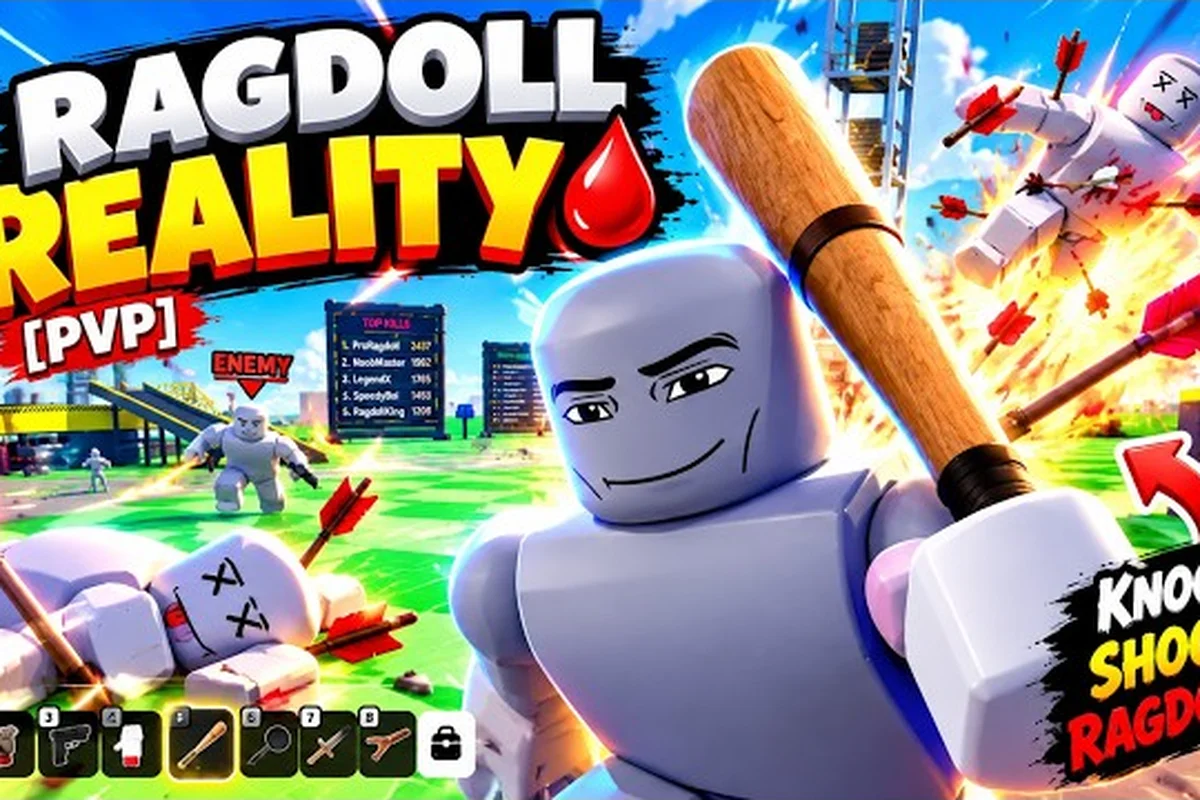
The ragdoll reality best minigun choice depends on whether you value steady crowd control, explosive reach, or fast close-range movement. Get the weapon breakdown, practical horde tactics, and clear tier guidance below.
Best Minigun Overview: Which Weapon Fits the Job?
The ragdoll reality best minigun is a strong sustained-fire option when a wave keeps several targets close together and you need continuous pressure rather than a single precise hit. It is not automatically the best weapon in every situation, however, because the official game page does not publish damage, ammunition, cooldown, or fire-rate figures. This ranking is therefore an editorial judgment based on weapon roles, physics behavior, and the practical demands of Horde mode.
The official Ragdoll Reality page on Roblox says the game includes more than twenty weapons and specifically identifies Fists, Bat and Machete for close impact; Push and Grab as movement tools; Pistol, Shotgun, Sniper and Minigun for range; Rocket Launcher, Flamethrower and C4 for heavy effects. It also describes a Horde mode involving zombie waves, with slow, normal, and fast zombie classes. Because the roster contains tools built for different ranges and effects, the most useful weapon depends on the problem you are trying to solve.
A minigun excels when enemies gather in a corridor, around an objective, or near a physics prop. The rocket launcher solves a narrower but more dramatic problem: breaking up a cluster from a safer distance. The flamethrower pressures a packed area with sustained area denial, while the pistol offers controlled ranged attacks when ammunition and precision matter more than saturation.
| Player need | Strong candidate | Main advantage | Main limitation |
|---|---|---|---|
| Sustained crowd control | Minigun | Continuous fire against grouped targets | Less useful against isolated, moving enemies |
| Explosive group damage | Rocket Launcher | Strong impact in a crowded area | Slower deliberate aiming and relocation |
| Area denial | Flamethrower | Persistent fire across a compact space | Narrow range and close positioning |
| Controlled ranged pressure | Pistol | Precision with less visual flooding | Less effective against dense crowds |
| Fast close-range impact | Bat | Immediate swing-based damage | Exposes the player to surrounding enemies |
| Mobile melee pressure | Machete | Reach and aggressive close-range use | Requires risky positioning |
This table is a role-based guide, not an official power ranking. The official page names the weapons but does not rank them, and community reports emphasize that rankings can change as updates add new equipment. For a broader view of how weapons fit into the sandbox, compare the Ragdoll Reality tier list by weapon role.
How this weapon comparison works
This comparison uses four practical criteria: sustained crowd control, explosive power, precision, and close-range impact. These criteria matter because Ragdoll Reality rewards interacting with a physically reactive sandbox rather than relying on a single damage statistic. A weapon that creates space, controls a route, or lets you reposition safely can be more valuable than one that merely looks powerful.
The final tier is S-Tier for weapons that excel in a broad horde scenario, A-Tier for dependable specialists, B-Tier for situational tools, and C-Tier for options that remain useful only with the right setup. Because exact damage and ammunition data are not published, those labels describe practical value rather than measured power.
Best Minigun vs. Ranged Rivals
The minigun’s defining advantage is continuous pressure. When multiple zombies approach along the same route, a steady stream of fire can keep them occupied while the player handles positioning and objective defense. That makes the ragdoll reality best minigun a dependable answer to standard waves, especially when enemies bunch together around props or narrow entrances.
The rocket launcher offers a different crowd-control solution. Its impact is explosive and area-based, so it can disrupt a dense formation without requiring sustained tracking. Yet that advantage comes with a tradeoff: aiming and repositioning around a powerful impact are less forgiving than simply maintaining a minigun stream. The official page identifies both weapons but provides no cooldown or ammunition figures, so their effective timing must be judged in play.
| Attribute | Minigun | Rocket Launcher | Flamethrower | Pistol |
|---|---|---|---|---|
| Primary role | Sustained suppression | Explosive area pressure | Area denial | Precise ranged pressure |
| Best target pattern | Dense, advancing groups | Clustered enemies | Enemies entering a narrow zone | Isolated or moving targets |
| Positioning | Medium range | Medium-to-long range | Close-to-medium range | Medium-to-long range |
| Control style | Continuous tracking | Deliberate burst | Sweeping fire | Selective shots |
| Main risk | Sustained use without escape space | Missed launch and awkward recovery | Enemy pressure at close range | Lower crowd saturation |
The pistol is the precision-focused member of this group. In ordinary combat, controlled shots can be preferable to flooding the screen, especially when a single dangerous target needs attention. In Horde mode, that advantage narrows because speed and crowd saturation matter more. The pistol is therefore best viewed as a reliable backup rather than the primary answer to a large wave.
The flamethrower occupies the space between continuous fire and area denial. Its narrow cone rewards careful positioning, while the persistent effect punishes enemies that remain inside it. It is especially effective when the battlefield provides a narrow approach, but less dependable when zombies can surround the player from several directions.
Choosing a ranged weapon by encounter type
Use the minigun when enemies repeatedly travel through the same area, when you can rotate while firing, and when a long engagement is preferable to a risky burst. Use the rocket launcher when a clearly grouped target can be hit with one decisive impact. Bring the pistol for precision, and use the flamethrower when you can hold a choke point or discourage enemies from crossing a specific zone.
This is why the ragdoll reality best minigun is persuasive for sustained encounters, although it does not erase the tactical value of the ragdoll reality best rocket launcher. A player who repeatedly wins by creating distance and timing explosive hits may prefer the launcher, while a player who values steady coverage may choose the minigun. A specialist can outperform a generalist when the scenario matches the specialty.
Best Pistol, Bat, and Machete Compared
The pistol, bat, and machete represent three distinct approaches to survival. The pistol provides distance, the bat provides immediate close-range impact, and the machete offers reach with an aggressive melee profile. Their value depends less on raw spectacle than on how quickly a player can convert space into a safe attack window.
The precision advantage of the pistol makes it useful for thin targets, environmental hazards, and moments when overloading the screen with minigun fire would make it harder to identify priority threats. However, crowd control usually rewards volume. A pistol may win a one-on-one exchange, yet a horde can occupy the same lane and make each shot feel slow by comparison.
The bat is a physics-friendly close-range option. Its swings can create strong impact reactions among nearby dummies, making it useful when enemies are already within striking distance. The machete, by contrast, suits a player who wants to enter the group and maintain dangerous momentum. Neither can match a minigun’s reach, but both can punish close approaches that ranged players might otherwise need to avoid.
| Close-range tool | Ideal use | Strength | Weakness |
|---|---|---|---|
| Pistol | Single targets and safer positioning | Accurate ranged pressure | Limited crowd saturation |
| Bat | Immediate heavy impact | Strong close-range disruption | Must operate inside enemy range |
| Machete | Mobile melee pressure | Reach and attack tempo | Dangerous against surrounding groups |
| Minigun | Repeated waves and grouped enemies | Sustained control at range | Vulnerable when boxed in |
Community experience generally favors switching tools by pressure rather than treating one weapon as permanently superior. That approach also fits the game’s sandbox design because weapons have distinct physical identities. If you want a complete comparison of every named tool, the Ragdoll Reality best weapons for hordes guide expands on how ranged and melee options perform under wave pressure.
When melee beats automatic fire
Melee becomes preferable when the remaining enemies are few, the area is cramped, or a ranged weapon would force awkward camera movement. The bat is particularly useful when a target is already close and a strong impact would quickly free the space around it. The machete is better for players who can keep enemies on one side and maintain a steady attack rhythm.
None of these close-range tools should be treated as a universal replacement for the ragdoll reality best minigun. They become stronger when the battlefield allows safe entry, while the minigun becomes weaker when enemies surround the player. The decisive question is therefore not simply “Which weapon deals the most damage?” but “Which position can I hold long enough to use the weapon effectively?”
Best Rocket Launcher and Flamethrower Compared
The rocket launcher is the more explosive of the two heavy crowd-control choices. A successful launch can punish a tightly packed group and create a moment in which the player can move, reload, or redirect attention. Its value is highest when a crowd has formed a clear target rather than when enemies are approaching from several directions.
The flamethrower is more continuous and area-oriented. It fills a usable path with fire, which makes it excellent against enemies funneled into a predictable lane. Its weakness is that the effective area is narrower, so the player must maintain a safer line of approach. A flamethrower that faces the wrong direction offers little protection, while a rocket impact can still reach across a wider area.
| Explosive or area weapon | Damage pattern | Ideal battlefield | Practical risk |
|---|---|---|---|
| Rocket Launcher | Large, discrete impact | Open space with a clustered target | Wasted launch or exposed recovery |
| Flamethrower | Sustained area effect | Choke point or narrow approach | Close-range pressure and narrow coverage |
| Minigun | Continuous projectiles | Repeated movement through a shared lane | Ammunition or position pressure |
| C4 | Delayed explosive placement | Prepared traps and controlled approaches | Placement time and trigger timing |
The official page includes C4 among the named tools but does not publish its exact trigger behavior, damage, or timing. The same caution applies to every ranking in this guide: use the game’s own descriptions and your current playtest to verify numbers, because updates may alter how each weapon feels.
For explosive specialists, the ragdoll reality best rocket launcher is a top-tier choice in open encounters and packed groups. The ragdoll reality best flamethrower becomes stronger in tight spaces where enemies cannot easily surround the user. Neither is a universal replacement for automatic fire, but both can outperform the minigun when their environmental requirements are met.
Best Minigun Horde Strategy
Using the ragdoll reality best minigun effectively starts with controlling the direction of the wave. Identify the lane or objective that enemies must cross, then face that area before they spread across the map. Sustained fire works best when your coverage and the enemy path overlap continuously.
Positioning is more important than maximum aggression. Keep enough room to rotate without losing your firing angle, and avoid standing where enemies can close from behind. Physics props can help block approaches, but they can also scatter targets unpredictably. Use obvious objects to redirect or slow the group rather than expecting every collision to produce identical results.
| Horde phase | Recommended action | Why it works |
|---|---|---|
| Wave start | Establish a firing lane | Early shots meet a predictable group |
| First contact | Keep continuous fire on the main approach | Prevents enemies from spreading into the area |
| Encirclement risk | Rotate or switch weapons | Sustained fire alone cannot cover every side |
| Dense cluster | Hold fire for a rocket or explosive option | A burst can punish the packed formation |
| Final stragglers | Use pistol, bat, or machete | Precision and mobility finish isolated targets |
A practical loadout includes one primary crowd-control weapon, one precision or explosive backup, and one close-range safety tool. The minigun is a strong primary choice, the rocket launcher or flamethrower is the situational backup, and the pistol, bat, or machete handles threats that slip into melee range. The broader first-session basics guide can help new players learn the surrounding game systems before optimizing these combinations.
Practice methods that improve weapon handling
Test the minigun against a single target first, then increase the number of active dummies gradually. This reveals how quickly the aim settles and whether the fire pattern follows a moving physics body. After that, place enemies at different angles to test whether you can rotate without losing coverage.
Next, recreate the scenarios in which rivals shine. Test a narrow lane for the flamethrower, a clustered line for the rocket launcher, and isolated moving targets for the pistol. Do not treat these as laboratory measurements; they are controlled practice cases that make the weapons’ strengths and weaknesses easier to recognize.
Finally, practice switching at the right moment. Holding the minigun until enemies are already touching you wastes its advantage, while switching too early can waste an explosive opportunity. The best player in a horde is often the one who changes tools without panicking.
Final Weapon Ranking for Every Play Style
Our final ranking places the minigun at S-Tier for reliable group suppression, the rocket launcher at A-Tier for high-impact situations, and the flamethrower at A-Tier for lane control. The pistol ranks as B-Tier because its precision is useful but its crowd value is limited, while the bat and machete occupy B-Tier as close-range specialists that thrive when enemies enter their effective range.
| Tier | Weapon | Why it earns its place |
|---|---|---|
| S-Tier | Minigun | Best sustained option for conventional group pressure |
| A-Tier | Rocket Launcher | Powerful area impact when a cluster is clearly formed |
| A-Tier | Flamethrower | Excellent at holding narrow approaches |
| B-Tier | Pistol | Precise, flexible, and useful as a backup |
| B-Tier | Bat | Strong close-range disruption |
| B-Tier | Machete | Mobile melee pressure with useful reach |
This ranking is intentionally situational. The minigun’s S-Tier position reflects consistency across standard horde waves, not a claim that it wins every isolated duel. The bat and machete can become the most important tools when enemies close the distance, and the rocket launcher can transform a hopeless-looking cluster if the player creates enough space for a reliable shot.
The minigun is therefore the best general answer for players who want continuous control, while the best rocket launcher, flamethrower, pistol, bat, and machete choices each solve a narrower problem. Select the weapon that matches the threat, protect your firing angle, and keep one backup for the moment automatic fire can no longer cover the battlefield.
Frequently Asked Questions
Is the minigun the strongest weapon in Ragdoll Reality?
The minigun is one of the strongest general crowd-control choices because its sustained fire can pressure several advancing enemies at once. It is not objectively strongest in every scenario, however. The rocket launcher, flamethrower, pistol, bat, and machete can outperform it when precision, area denial, or close-range timing matters more.
When should I use the rocket launcher instead of the minigun?
Use the rocket launcher when enemies form a tight, clearly visible group and you have enough space to aim safely. It offers a decisive area impact that can punish clustered targets without sustained tracking. The minigun remains better for repeated pressure, moving crowds, and waves that keep entering from one direction.
Is the flamethrower effective for crowd control?
The flamethrower is highly effective when it can cover a narrow approach or choke point. Its sustained fire discourages enemies from crossing the occupied area and can create space before they reach the player. It is less reliable in open terrain or against enemies approaching from several sides, where its narrow coverage becomes a disadvantage.
Should I use the bat or machete in close combat?
Both are valuable when enemies get inside ranged range. The bat is suited to forceful close-range impact, while the machete fits players who prefer mobile melee pressure and reach. They work best when the player can control the surrounding space; if several enemies surround the position, switching to a ranged tool may be safer.
What makes the ragdoll reality best minigun useful in Horde mode?
The minigun’s main value is sustained suppression across a predictable enemy path. It lets players maintain pressure while a wave approaches, especially when zombies gather in a corridor or around an objective. Its usefulness falls when enemies surround the player from multiple sides, so movement and backup-weapon switching remain essential.